在学术出版流程中,摘要(Abstract)是整篇论文中阅读量最高、传播最广的模块。
无论是在 IEEE Xplore、ACM Digital Library、PubMed 还是 Google Scholar 上,读者和审稿人(Reviewers)在决定是否下载全文、引用论文或直接拒绝(Desk Reject)之前,首先阅读的就是摘要。
一篇优秀的摘要需要在 150 至 250 个单词 的有限篇幅内,精准、客观、完整地浓缩整篇论文的学术精华。
以下为您拆解国际通行的高分 Abstract 写作逻辑、五步结构公式及万能模板。
一、 摘要的底层结构:“五步法”公式(The 5-Sentence Framework)
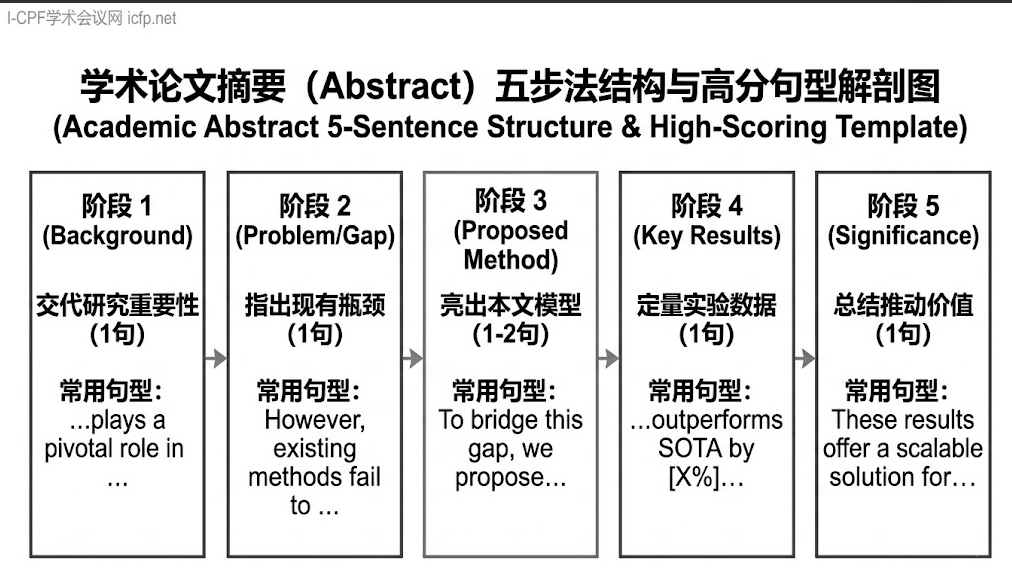
绝大多数高水平学术期刊和顶级会议(CCF A类、IEEE/ACM 旗舰会议)的摘要,都遵循极度严谨的“五步法”结构。每一句话都承担着特定的学术传达功能:
                       [ 高分 Abstract “五步法”结构 ]
                                     │
      ┌──────────────────────────────┼──────────────────────────────┐
      ▼                              ▼                              ▼
【第 1 句:研究背景 (Background)】 【第 2 句:研究痛点 (Problem)】 【第 3 句:核心方法 (Method)】
 - 阐明该领域的重要价值/现状     - 指出当前方法存在的局限与瓶颈  - 引入本文提出的新模型/新理论
                                     │
                     ┌───────────────┴───────────────┐
                     ▼                               ▼
              【第 4 句:主要结果 (Results)】 【第 5 句:学术价值 (Significance)】
               - 列出具体实验数据/提升幅度      - 总结成果对领域的实际推动意义
-
第一句:研究背景与领域上下文(Background & Context)
-
功能:交代研究方向,说明该主题为什么重要。
-
常用动词:plays a critical role in, has emerged as a key technology, is essential for
-
-
第二句:现有研究瓶颈与难题(Problem Statement / Research Gap)
-
功能:指出目前主流方法存在的缺陷,导出本文的研究必要性。
-
常用转折词:However, existing approaches suffer from, despite its success, current methods fail to
-
-
第三句:本文提出的核心方法与创新点(Proposed Method / Solution)
-
功能:亮出己方方案,明确提出本文的模型、算法、框架或理论。
-
常用动词:In this paper, we propose / introduce / present, to address this, we design
-
-
第四句:核心实验结果与量化数据(Key Findings & Empirical Results)
-
功能:用具体的数据和指标说话,展现方法的效果。
-
写作红线:切忌仅使用模糊的形容词(如 much better),必须使用定量数据(如 improves accuracy by 14.2%)。
-
-
第五句:总结与学术/工程价值(Conclusion & Significance)
-
功能:阐明本研究对该领域未来发展的推动作用或应用价值。
-
常用动词:demonstrates the potential for, paves the way for, offers a novel perspective on
-
二、 万能英文 Abstract 高分模板(按研究类型分类)
模板一:算法/工程/实验类论文(最常用)
[Background] [Field/Technique] plays a pivotal role in [Application Domain]. [Problem] However, existing methods often fail to achieve [Goal] due to [Specific Bottleneck, e.g., high computational cost / noise sensitivity]. [Method] To overcome this limitation, we propose [Model/Method Name], a novel [Type of Framework] designed to [Core Function]. Specifically, our approach incorporates [Key Component 1] to [Function 1] and leverages [Key Component 2] for [Function 2]. [Results] Extensive experiments on [Number] benchmark datasets demonstrate that [Model Name] consistently outperforms state-of-the-art baselines, achieving a [Specific Numeric Improvement, e.g., 12.5% increase in F1-score] while reducing [Cost/Latency] by [X%]. [Significance] These results indicate that our method offers a scalable and effective solution for [Broader Application].
模板二:理论/机制/分析类论文
[Background] Understanding the mechanism of [Scientific Phenomenon] is fundamental to advancing [Research Field]. [Problem] Despite extensive studies, the underlying relationship between [Variable A] and [Variable B] remains elusive. [Method] In this study, we establish a comprehensive theoretical framework to analyze [Target Phenomenon] under [Specific Conditions]. By combining [Theory/Analytical Tool A] with [Method B], we systematically derive [Key Equation/Model]. [Results] Our analysis reveals that [Key Finding 1], and identifies [Key Finding 2] as a critical factor influencing [Outcome]. [Significance] This work provides new insights into [Field] and establishes a theoretical foundation for future designs of [System/Application].
三、 摘要写作的高频句型库与避坑红线
1. 高频表达短语分类
-
表述研究痛点:
-
Traditional approaches heavily rely on ..., which limits their scalability in ...
-
A major challenge in this area is the lack of ...
-
-
引出本文方案:
-
To bridge this gap, we develop an end-to-end architecture termed ...
-
In response to these issues, this work presents a novel ...
-
-
展示量化结果:
-
Empirical evaluations show that our framework outperforms SOTA baselines by a significant margin.
-
Compared to the strongest baseline, our method reduces memory consumption by [X%].
-
2. 三大必须规避的致命红线
-
红线一:严禁在摘要中直接引用参考文献(References)
-
摘要必须具备完全的独立性(Self-contained)。严禁在摘要中出现
[1]、(Smith et al., 2024)等引用标记。
-
-
红线二:严禁使用未定义的缩写或冷门专业俗语
-
首次出现的专业缩写(如 LLM、GNN)在摘要中若非常规通用术语,建议写出全称后加括号缩写。
-
-
红线三:时态混用错乱
-
背景与客观真理:使用一般现在时(Present Simple);
-
介绍自己完成的工作与实验:使用一般过去时(Past Simple)或一般现在时(阐述论文自身时用 Present Simple,如 This paper proposes...)。
-
上一篇
论文怎么写?从零开始写一篇学术论文的完整方法
中国首位!新晋院士候选人,获国际大奖
- 74
- 发布时间:2026.08.06
第八届电力与能源技术国际会议(ICPET 2026)在蓉开幕
- 137
- 发布时间:2026.07.30

饶毅、倪忆两位教授发文澄清:四位北大教师为王虹赴法留学撰写推荐信
- 301
- 发布时间:2026.07.29
港大校长张翔宣布2028年卸任,称盼重返实验室专注科研
- 320
- 发布时间:2026.07.28
截稿日期在2026年8月的重点会议推荐_8月EI学术会议盘点
- 391
- 发布时间:2026.07.24