在学术论文的评阅过程中,引言(Introduction)是审稿人(Reviewers)决定论文命运的最关键章节。
很多期刊主编(Editor-in-Chief)和会议领域主席(Area Chair)在审稿时,读完 Abstract(摘要)后就会直奔 Introduction。如果引言部分逻辑混乱、未能清晰表达研究痛点(Research Gap)或没有说服力地呈现核心贡献(Contributions),论文极易被直接标记为 Desk Reject(直接拒稿)。
引言的本质是告诉审稿人一个逻辑严密的“学术故事(Academic Storyboarding)”:“为什么这个方向很重要?现有研究有什么致命缺陷?我们提出了什么创新方案?带来了什么突破?”
以下为您拆解国际通行的 Introduction 漏斗型写作思路、段落推进逻辑与高分范文。
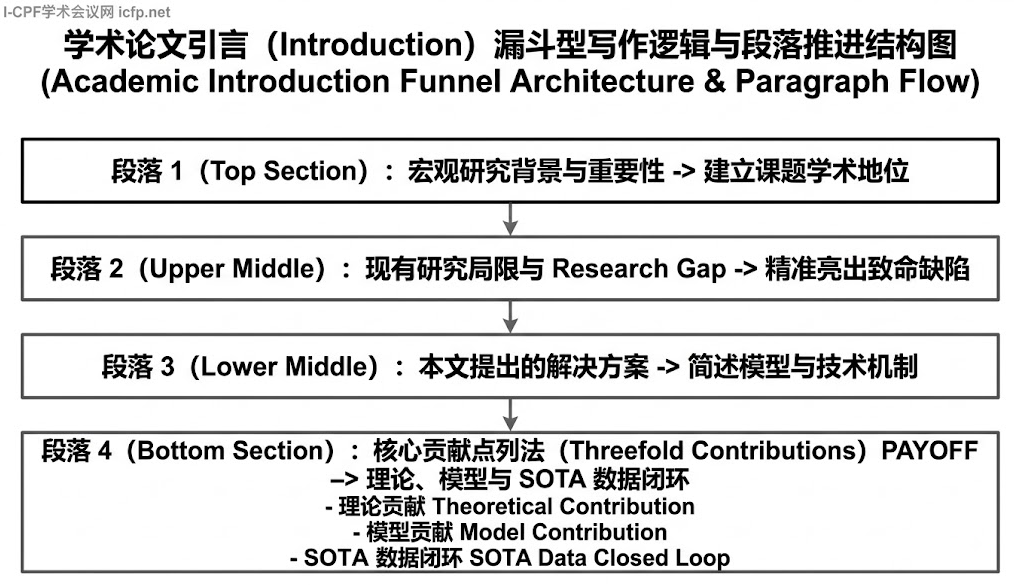
一、 引言的底层架构:四段式“漏斗型(Funnel)”逻辑推进
高水平学术论文的 Introduction 严格遵循“由宏观到微观、由行业痛点到己方方案”的倒金字塔/漏斗型结构。一般控制在 4 到 5 个段落(约 1 至 1.5 页):
                      [ 引言 Introduction 漏斗型结构 ]
                                     │
      ┌──────────────────────────────┼──────────────────────────────┐
      ▼                              ▼                              ▼
【第一段:宏观背景与重要性】   【第二段:现有研究与 Research Gap】  【第三段:本文方案与技术机制】
 - 领域应用价值/学术地位        - 总结主流方法与致命缺陷         - 引入本文模型/框架的设计逻辑
                                     │
                                     ▼
                      【第四段:核心贡献点列法 (Contributions)】
                       - 明确提炼 3-4 点明确的理论/实验突破
1. 第一段:领域背景与研究重要性(Context & Importance)
-
写作目标:迅速锁定研究方向,向审稿人证明该课题具备广泛的应用前景或深厚的理论价值。
-
常用句型:
-
[Research Topic] has emerged as a fundamental paradigm in [Broader Field], with applications ranging from [App 1] to [App 2].
-
Recent years have witnessed remarkable progress in [Technique/Field], driven by [Driver/Data/Hardware].
-
2. 第二段:现有方法与研究缺口(Related Methods & Research Gap)
-
写作目标:梳理目前主流的解决方案,并精准指出现有方法的致命缺陷(Critical Bottleneck)。这是整个引言的“承上启下”枢纽。
-
过渡与转折技巧(从赞扬到指出缺陷):
-
Despite these impressive achievements, current approaches still suffer from [Specific Limitation].
-
However, most existing frameworks fail to account for [Unresolved Factor], leading to suboptimal performance in [Scenario].
-
3. 第三段:本文提出的解决方案(Proposed Solution)
-
写作目标:顺理成章地亮出自己的方法,解释“我们如何巧用新机制克服了第二段提到的缺陷”。
-
常用句型:
-
To address these challenge(s), in this paper, we propose [Model Name], a novel [Framework Type] specifically designed for [Problem].
-
The key insight behind [Model Name] is to integrate [Mechanism A] with [Mechanism B], thereby enabling...
-
4. 第四段:提炼核心贡献(Summary of Contributions)
-
写作目标:用点列式(Bullet Points)明确回答:“这篇文章到底给学术界带来了什么增量?”
-
标准列举格式:
Our main contributions are summarized as follows:
-
[Methodological Novelty]: We design/propose [Model Name], a novel framework that effectively resolves [Problem] via [Key Mechanism].
-
[Theoretical/Architectural Insight]: We introduce [Component A] to achieve [Function], which theoretically guarantees [Advantage].
-
[Empirical Demonstration]: Extensive experiments on [X] real-world benchmark datasets demonstrate that our method achieves SOTA performance, outperforming strong baselines by [Y%].
-
二、 顶会高分范文逐句深度剖析
以下为您拆解一篇发表于计算机与 AI 顶级会议的典型高分 Introduction 范文逻辑:
【范文片段】
[Paragraph 1: Context] Graph Neural Networks (GNNs) have demonstrated extraordinary capabilities in modeling non-Euclidean data, becoming the de facto standard for graph-based learning tasks. [Paragraph 2: Gap] Despite their empirical success, existing GNN models predominantly suffer from the over-smoothing problem when the architecture goes deeper, where node representations become indistinguishable. Current attempts to mitigate this issue either introduce heavy computational overhead or sacrifice the receptive field size. [Paragraph 3: Solution] To bridge this gap, we present DeepGraph, a lightweight and scalable deep graph architecture. The core innovation of DeepGraph lies in a dynamic residual-attention gating mechanism that selectively preserves multi-hop neighborhood features while preventing feature homogenization. [Paragraph 4: Contributions] The primary contributions of this work are threefold: (1) We identify the root cause of over-smoothing from an information-theoretic perspective... (2) We propose DeepGraph, featuring a novel dynamic gating mechanism... (3) We conduct extensive evaluations across five benchmarks, proving that DeepGraph outperforms SOTA baselines with a 40% reduction in GPU memory.
【范文逻辑亮点】
-
开篇立论:1 句话定义 GNNs 的学术地位;
-
痛点精准:直接指名道姓 over-smoothing problem,并说明现有补救措施(轻量计算与感受野)的不可兼得;
-
方案对接:用 To bridge this gap 接出己方模型,并简要说明其核心机制(动态残差注意力门控);
-
贡献清晰:从理论认知、模型创新、实验提升(包含 40% 显存降低)三个角度形成闭环。
三、 避坑指南:引言写作三大致命禁忌
-
禁忌一:文献综述(Related Work)占比过高,喧宾夺主
-
引言中的第二段只需要点出与你课题直接冲突的最核心文献与缺陷即可,切忌把引言写成面面俱到的文献综述大杂烩。
-
-
禁忌二:没有写明与自己之前发表成果的区分(针对 Extension 论文)
-
如果论文是基于先前会议论文的扩展版本(Journal Extension),必须在引言结尾明确说明:“A preliminary version of this work appeared in [Conference Name] [1]. In this journal version, we significantly extend...”
-
-
禁忌三:贡献描述过于宽泛(Vague Claims)
-
严禁在贡献部分使用 "We achieve good performance" 或 "We propose a better model"。必须使用量化数字(如 15% AP improvement)和清晰的技术名称(如 a multi-scale attention module)。
-
上一篇
论文摘要怎么写?Abstract 写作结构与高分模板全解析
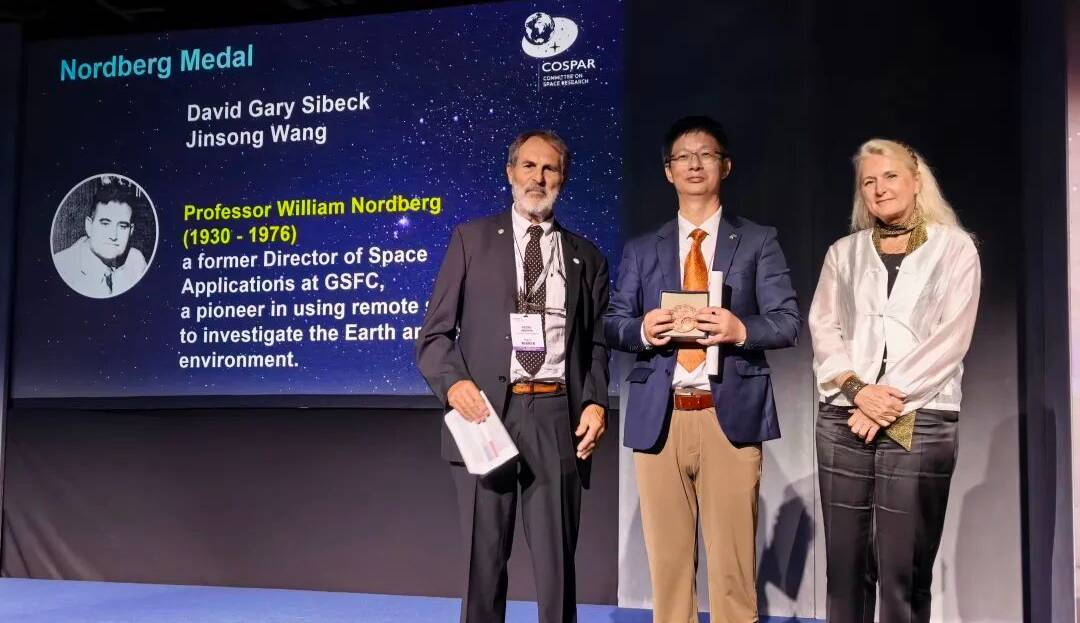
中国首位!新晋院士候选人,获国际大奖
- 74
- 发布时间:2026.08.06
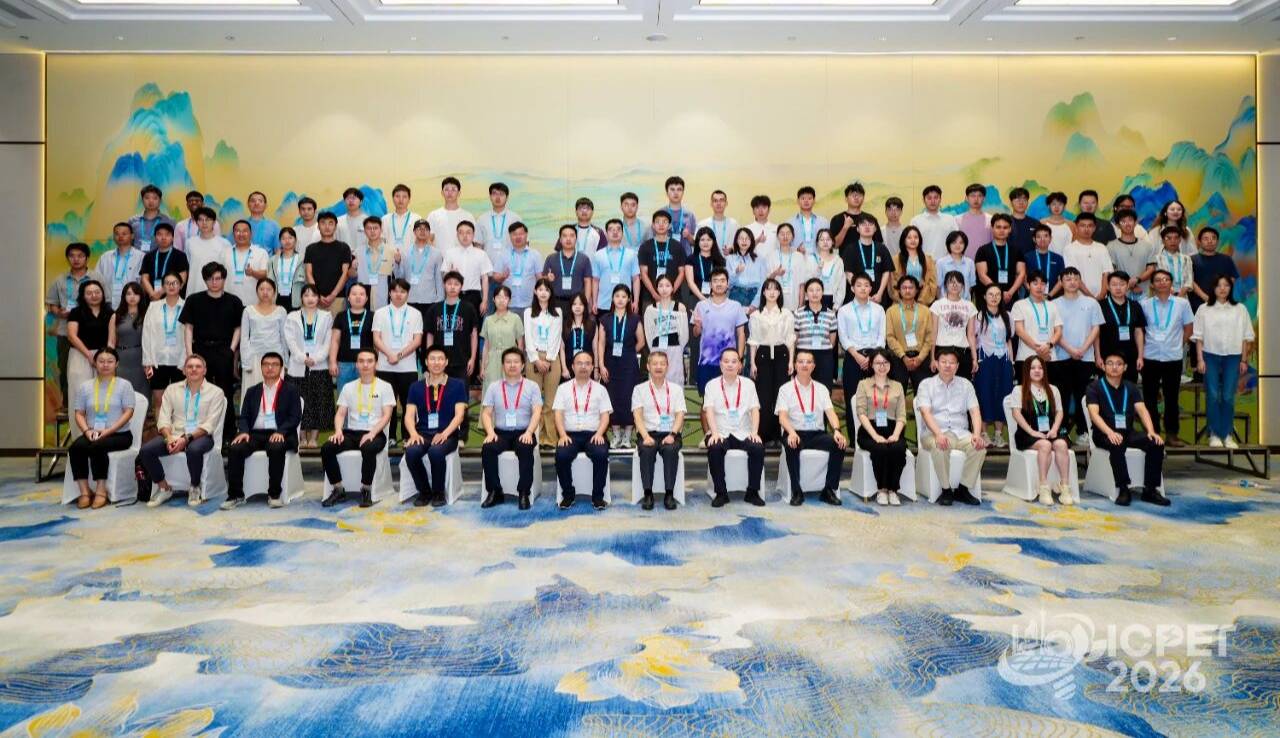
第八届电力与能源技术国际会议(ICPET 2026)在蓉开幕
- 138
- 发布时间:2026.07.30
饶毅、倪忆两位教授发文澄清:四位北大教师为王虹赴法留学撰写推荐信
- 301
- 发布时间:2026.07.29
港大校长张翔宣布2028年卸任,称盼重返实验室专注科研
- 321
- 发布时间:2026.07.28

截稿日期在2026年8月的重点会议推荐_8月EI学术会议盘点
- 391
- 发布时间:2026.07.24