在学术论文写作中,结论(Conclusion) 是整篇论文的“终章”,也是审稿人(Reviewers)和读者阅读完全文、评估该研究总体价值后的最后落脚点。
然而,许多初学者在撰写 Conclusion 时常犯一个致命错误:直接把 Abstract(摘要)或 Discussion(讨论)段落进行同义词替换后重新复制一遍,仅做简单的“复述与总结”。
在顶级期刊和计算机/工程类顶会(如 IEEE、ACM、CCF A类)的评审标准中,这种敷衍式的总结极易被审稿人标记为“缺乏深度洞察(Lack of Deep Insights)”。
为什么 Conclusion 绝对不能只是简单的总结?如何写出一个逻辑严密、具备学术升华感的高分 Conclusion?以下为您拆解其底层逻辑与撰写模板。
一、 核心解惑:为什么 Conclusion 不能只是简单的总结?
许多作者困惑:“我在前面的摘要、引言和实验章节已经把方法和数据说清楚了,结论不就是复述一下结论吗?”
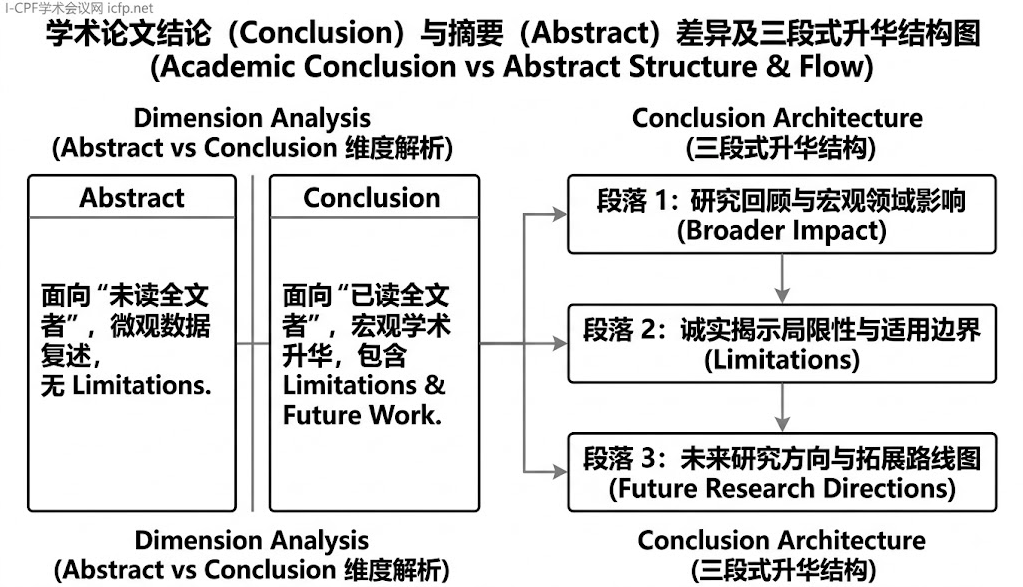
从学术出版与同行评审的角度来看,Abstract 与 Conclusion 承担着截然不同的功能:
| 对比维度 | 摘要 (Abstract) | 结论 (Conclusion) |
| 阅读场景 | “没读全文之前”:吸引读者下载并阅读全文 | “读完全文之后”:给已掌握实验细节的读者的最终定论 |
| 核心视角 | 微观成果视角:提出了什么模型,数据提升了多少 | 宏观价值视角:该研究对本领域/行业带来了什么深远改变 |
| 必要模块 | 领域背景、痛点、方法、数据、结论(完整五步) | 研究突破升华、理论/工程局限性(Limitations)、未来路线 |
| 致命禁忌 | 包含具体文献引用或过长的细节推导 | 纯粹机械地同义改写 Abstract,没有任何增量信息 |
Conclusion 的真正使命是“学术升华(Elevation)”:
-
回答“So What?”(那又怎样?):读者已经看到了你的实验数据很优秀,Conclusion 需要告诉读者:这个数据提升对该领域未来的算法设计、系统落地或理论演进意味着什么。
-
展现科学严谨性(Scientific Honesty):任何科研成果都有其边界条件。在 Conclusion 中客观阐述研究的局限性(Limitations),不仅不会降低论文质量,反而能展现作者严谨的学术态度。
-
为后续研究者“指明方向(Roadmap)”:通过提出有建设性的未来工作(Future Work),引导同行在你的研究基础上继续深挖,这是拉升论文长期引用量(Citations)的关键。
二、 高分 Conclusion 的三段式标准架构
一篇高质量的学术论文 Conclusion 通常包含 3 个核心段落(约 200 至 300 字):
                      [ 高分 Conclusion 三段式结构 ]
                                     │
      ┌──────────────────────────────┼──────────────────────────────┐
      ▼                              ▼                              ▼
【第一段:核心成果与宏观升华】      【第二段:局限性与边界条件】     【第三段:未来工作路线图】
 (Summary & Broader Impact)         (Limitations & Boundary)       (Future Research Directions)
 - 概括主要发现,但侧重于宏观      - 诚实指出模型适用边界/数据局   - 提出明确、可落地的后续研究
   对领域的推动与范式改变             限/计算复杂度瓶颈               方向(引导同行引用)
1. 第一段:研究回顾与宏观影响(Summary & Broader Impact)
-
写作要点:简要重申论文解决的核心痛点,但重点落在该方案带来的范式转变或实用价值上。
-
常用句型:
-
In this paper, we have presented [Model Name], a novel framework designed to address [Problem].
-
Beyond the numerical improvements, our findings demonstrate that integrating [Mechanism A] with [Mechanism B] provides a viable path toward [Broader Field Goal].
-
2. 第二段:研究局限性与适用边界(Limitations)
-
写作要点:主动、客观地指出当前方法的不足(例如:仅在特定数据集上验证过、高并发场景下计算开销较大、未考虑极端噪声等)。
-
常用句型:
-
Despite the promising results, several limitations of this work should be acknowledged.
-
First, our model relies on [Assumption/Data Type], which may not hold in [Edge Scenario]. Second, the computational complexity scales quadratically with...
-
3. 第三段:未来研究方向(Future Work)
-
写作要点:基于第二段提到的局限性,给出具体的改进计划或延伸研究思路。
-
常用句型:
-
To overcome these constraints, our future work will focus on two key directions.
-
First, we plan to extend [Model Name] to [New Domain/Data Type]. Second, we aim to optimize the memory footprint to enable real-time deployment on edge devices.
-
三、 万能英文 Conclusion 高分范文模板
[Paragraph 1: Summary & Impact]
In this work, we have introduced [Model Name], a new architectural approach to solving [Core Challenge] in [Field Domain]. By combining [Key Technique A] with [Key Technique B], our method effectively bridges the gap between [Aspect 1] and [Aspect 2]. Extensive empirical evaluations across [Number] benchmarks confirm that [Model Name] not only achieves state-of-the-art performance but also significantly enhances interpretability. These insights suggest that [Core Mechanism] can serve as a robust building block for next-generation [Systems/Algorithms].
[Paragraph 2: Limitations]
Nevertheless, certain limitations warrant consideration. Currently, the performance of [Model Name] depends on the availability of high-quality labeled data, which may restrict its applicability in ultra-sparse or highly noisy environments. Additionally, the attention mechanism introduces additional memory overhead during the inference phase.
[Paragraph 3: Future Work]
Future research can build upon this work in several promising directions. We intend to explore self-supervised pre-training techniques to alleviate the dependency on labeled datasets. Furthermore, we aim to lightweight the network topology for edge-computing applications, thereby broadening the practical utility of our approach in real-world scenarios.
上一篇
论文引言怎么写?Introduction写作思路与范文解析
中国首位!新晋院士候选人,获国际大奖
- 74
- 发布时间:2026.08.06
第八届电力与能源技术国际会议(ICPET 2026)在蓉开幕
- 138
- 发布时间:2026.07.30
饶毅、倪忆两位教授发文澄清:四位北大教师为王虹赴法留学撰写推荐信
- 301
- 发布时间:2026.07.29
港大校长张翔宣布2028年卸任,称盼重返实验室专注科研
- 321
- 发布时间:2026.07.28
截稿日期在2026年8月的重点会议推荐_8月EI学术会议盘点
- 391
- 发布时间:2026.07.24